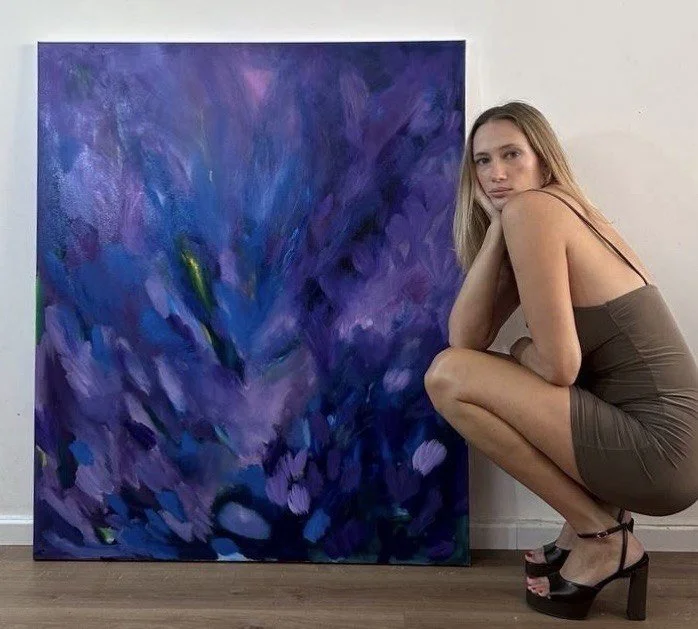
Olga Goldenberg, born in 1989 in Belarus, is an abstract artist based in Tel Aviv, Israel. Her work is shaped by the contrast between her Eastern European roots and the cultural landscape of the Middle East, exploring the relationship between memory, emotion, color, and place.
Growing up in the Belarusian countryside during the years following the collapse of the Soviet Union, Olga experienced a world defined by contrasts: social and economic uncertainty alongside the quiet permanence of nature. These early impressions continue to inform her visual language and her sensitivity to tension, balance, and transformation.
Olga’s artistic foundation began early, with four years of formal art training in Belarus, culminating in a diploma. She later pursued studies in economics, while art remained an enduring part of her life. From the age of 18, she also worked as a model, developing a close relationship with photography, composition, and visual expression.
In her 30s, Olga moved to Israel, where a new cultural and visual environment became another influence on her practice. The meeting of her Eastern European background with the intensity, light, and energy of the Middle East gradually became part of the language of her work.
Olga approaches painting intuitively, beginning without a predetermined composition. Through layers of color, spontaneous gestures, and evolving forms, each work develops through the process of painting itself. Rather than illustrating a specific narrative, she allows personal memories, emotions, and subconscious associations to emerge organically on the canvas.
Her abstract paintings explore contrasts between strength and softness, intensity and stillness, structure and spontaneity. Color plays a central role in her work, creating both emotional tension and a sense of movement beneath the surface.
For Olga, painting is a process of discovery — a way of translating experiences that are difficult to express through words into color, gesture, and form. Her work reflects an ongoing dialogue between past and present, different cultures and places, and the inner and external worlds.